
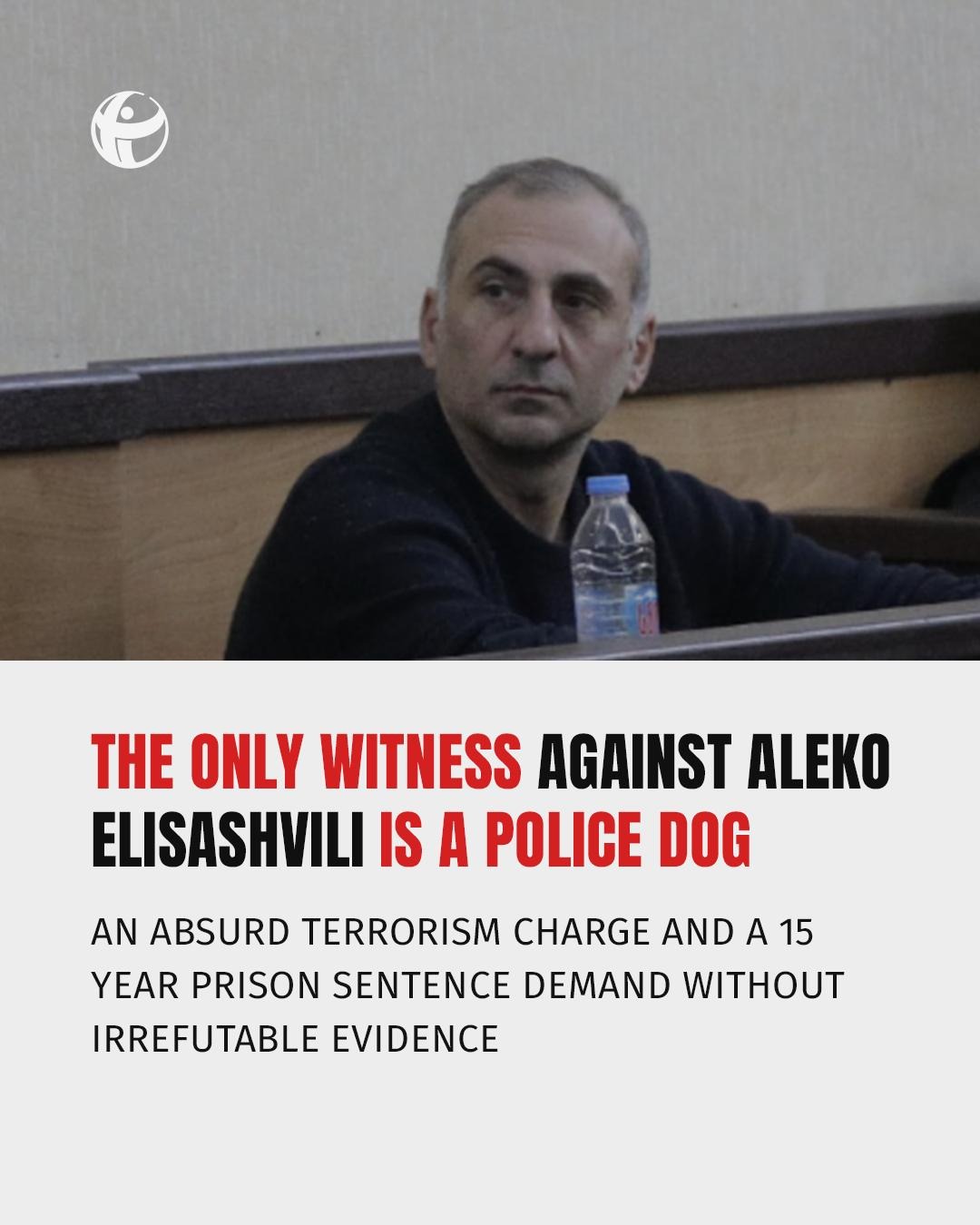
“Terrorism” Charge Based on a Scent Allegedly Identified by Dogs: Ivanishvili’s Prosecutor’s Office Has Framed Yet Another Case Against Aleko Elisashvili
Introduction
Some time ago, Transparency International Georgia published an article analysing the case concerning the conviction of prominent opposition politician and former journalist Alexander (Aleko) Elisashvili.[1]
In its judgment of 10 July 2026, the Tbilisi City Court found Alexander Elisashvili guilty of an attempt to commit a terrorist act, as provided for by Article 323(1) of the Criminal Code, and sentenced him to 13 years’ imprisonment.
In our assessment, the court failed to establish beyond reasonable doubt the existence of a terrorist purpose in Elisashvili’s conduct, thereby violating his right to a fair trial and other rights guaranteed by the European Convention on Human Rights. We therefore concluded that Alexander Elisashvili should be regarded as a political prisoner, as he meets the criteria for a political prisoner established by PACE Resolution 1900 (2012).[2]
The Tbilisi City Court is currently hearing another case against Aleko Elisashvili, in which he is likewise charged with setting fire to the courthouse for a terrorist purpose. Unlike the first case, however, where there is no doubt that Aleko Elisashvili himself attempted to set the fire, in the present case the prosecution is unable to establish not only the existence of a terrorist purpose, but even that Elisashvili committed the incriminated act—setting the fire.
Moreover, the prosecution’s case is so devoid of the coherent, clear and convincing body of evidence necessary to sustain a conviction that, even among the numerous politically motivated cases brought under the Ivanishvili regime, this case stands out for the particular weakness of the prosecution’s position and the striking paucity of its evidentiary basis.
In fact, the only evidence on which the prosecution relies is an odourological expert report which, according to the prosecution, allegedly establishes that the scent samples collected from the crime scene were identified by a dog from the Ministry of Internal Affairs’ Canine Service as matching Elisashvili’s scent sample. Yet, as we will see, even this sole piece of evidence raises serious doubts as to its lawfulness and reliability.
I. Facts
1. The alleged offence and the results of the investigation during the first eight months following its commission
According to the case materials, on 4 May 2025 the Ministry of Internal Affairs opened an investigation into damage to property by arson under Article 187(2)(a) of the Criminal Code.[3] The investigation was initiated following a report received at 04:12 on 4 May stating that a fire had broken out at the rear of the Tbilisi City Court building and had been extinguished by the fire service summoned to the scene.[4]
According to the crime-scene inspection report drawn up that same morning, canine-service experts who arrived at the scene collected scent-trace samples “from the concrete surface in front of the damaged façade and from the surface of the stairs leading down to the basement”.[5] The collected scent samples were sealed in a special bag bearing a corresponding barcode, on which the case number and signatures were also recorded.[6]
That same day, on the basis of so-called “operational information”, a crime-scene inspection was conducted in the area around 3 Tinatin Virsaladze Street in the village of Digomi, near the Tbilisi City Court, from which two polyethylene bottle caps, burnt residue from polyethylene objects, and samples of burnt residue and soil were collected.[7]
That same morning, the head of the Information Technology and Communications Division of the Department of Common Courts was interviewed. He stated that he had reviewed recordings from the internal and external CCTV cameras installed at the administrative building of the Tbilisi City Court. The recordings showed an unidentified person in the rear courtyard of the court between approximately 03:40 and 04:10 on 4 May, during whose presence fires broke out at two locations at the rear of the courthouse. The interviewee stated that he had nothing further to report to the investigator in charge of the case.[8] The video recordings were seized pursuant to a court order.[9]
The following day, three court marshals from the Tbilisi City Court who had been on duty at the court on the night in question were interviewed. All three stated that at approximately 04:00 the fire alarm went off, that they immediately called 112 and requested assistance, that the fire service arrived at the scene and extinguished the fire shortly thereafter, and that they did not know the identity of the person who had committed the offence.[10]
A comprehensive chemical, fire-technical and commodity examination was ordered in the case.[11] It established that the cause of the fire was contact between an open flame source and petroleum products and combustible material, and that traces of heavy petroleum-product fractions were detected on the swabs collected from the scene.[12]
That is the full extent of what was done and discovered during the first days of the investigation. Thereafter, for more than eight months, the investigative authorities took no further investigative steps. At least, the case file contains no documents recording any such investigative action.
2. More than eight months after the incident, the investigation “picked up the trail” of Aleko Elisashvili
On 12 January 2026, more than eight months after the fire of 4 May 2025, Ucha Turmanidze, a detective of the Sixth Division of the Vake-Saburtalo Main Division of the Tbilisi Police Department, drafted a report addressed to his deputy division head, Shavlego Maisuradze. He stated that, according to “operational information” he had received, CCTV cameras installed on the external perimeter of several residential buildings on Akaki Kvantaliani Street in Vashlijvari and on the building of a company located on Rostevani Street had captured the movements of a person who might have been responsible for damaging the Tbilisi City Court building by fire on 4 May 2025.[13]
That same day, the detective was interviewed. He stated that he had received the operational information from a “personal contact” whom he “knows well” and who had previously provided him with “operational information relevant to solving crimes and to cases, which had always proved justified and been confirmed”.[14]
On the same and following days, the investigator interviewed five people living in houses on Akaki Kvantaliani and Rostevani Streets. All five told the investigator essentially the same story, described in virtually identical words. For example, one of them stated that:
- they lived at such-and-such address;
- CCTV cameras had been installed on the external perimeter of their residence, providing 24-hour monitoring and, simultaneously, storing the recorded footage;
- on 4 May 2025, police officers had come to their residence and expressed an interest in the CCTV cameras installed on the external perimeter;
- the police officers explained that the cameras might have captured the movements of a person of interest to them, dressed in dark clothing and with their face covered;
- they subsequently reviewed the recordings from the said CCTV cameras and indeed saw a person matching that description;
- they informed the police officers accordingly; and
- at the officers’ request, they copied the recordings and saved them on their personal mobile phone.[15]
As noted above, the other interviewees told exactly the same story.[16]
These video recordings, which, according to the narrative described above, had remained in the possession of these private individuals and which, for some reason, the police had not seized as early as 4 May 2025, were requested pursuant to a court order of 14 January 2026[17] and obtained on 16 and 17 January 2026.[18]
Approximately another two months then passed, and on 13 March 2026 another detective of the Sixth Division of the Vake-Saburtalo Main Division of the Tbilisi Police Department, Giorgi Razmadze, drafted a report addressed to his division head, Elizbar Bestavashvili. He stated that, according to yet another piece of “operational information” he had received, Alexander Elisashvili had set fire to the Tbilisi City Court building on 4 May 2025.[19] During his interview, the detective, like his colleague who had authored the previous report, stated that he had received the so-called “operational information” from a so-called “personal contact” whom he knew well and who had “provided operational information on numerous occasions, and the information provided by him had been successfully acted upon on every occasion.”[20]
3. Transfer of the case to the Prosecutor’s Office for investigation and reclassification of the offence
On 13 March 2026, First Deputy Prosecutor General Zurab Beltadze issued a decision transferring the investigation of the criminal case to the Investigative Division of the Tbilisi Prosecutor’s Office.[21]
On 20 March 2026, pursuant to a prosecutor’s decision, a habitoscopic examination was ordered in the case and assigned to the Expert-Criminalistics Department of the Ministry of Internal Affairs.[22]
On 25 March 2026, the department’s chief expert, Nino Borashvili, issued Expert Report No. 46/7/6-1188. According to the report, a habitoscopic and photo-video technical examination was conducted of the external CCTV recordings obtained from the above-mentioned five residents of Akaki Kvantaliani and Rostevani Streets, as well as photographs extracted from those recordings. According to the expert report, “the image of the person of interest to the investigation recorded in the videograms submitted for examination is unsuitable for identifying the person.” She further stated that the image of the person of interest to the investigation in a number of photographs extracted from the videograms was likewise unsuitable for identification. However, according to the expert, in several photographs it was possible “only to tentatively establish/recognise the person”.[23]
On 23 March 2026, the prosecutor-investigator in the case issued a decision ordering a biological examination of the burnt-residue and soil samples that had been collected.[24] However, according to Elisashvili’s lawyers, no expert report has been produced to date, despite more than six months having elapsed since the examination was ordered.
On 25 March 2026, Judge Arsen Kalatozishvili of the Tbilisi City Court issued an order for a scent sample to be taken from Alexander Elisashvili.[25] The order was executed and a scent sample was taken from Elisashvili on 26 March 2026.[26]
On 26 March 2026, the prosecutor issued a decision ordering an odourological examination. This examination was likewise assigned to the Expert-Criminalistics Department of the Ministry of Internal Affairs.[27]
On 27 March 2026, the department’s chief experts, Manuchar Chikhradze and Dimitri Nachkebia, prepared Report No. 46/9-109.[28] In this extremely concise report, which consists of only four pages including a photographic annex, with the description of the examination occupying less than one incomplete page and the actual conclusions consisting of a single paragraph, we read:
“The scent-trace samples collected from the scene were placed in containers available in the laboratory of the Odourological Examination Division, together with other scent-trace samples, and were compared, using specially trained service dogs, with the scent sample taken from Alexander Elisashvili.”
“In criminal case No. 007040525003, concerning the fact of damage by fire to the Tbilisi City Court building on 4 May 2025, the scent-trace samples collected from the scene, namely from the surface of the stairs leading down to the basement in the courtyard of the Tbilisi City Court and from the concrete surface in front of the damaged façade, are identical to the scent sample taken from Alexander Elisashvili.”
Neither the description of the examination nor the concluding paragraph says anything more about:
- the sequence and duration of the examination process;
- whether there were any interruptions or irregularities;
- whether the containers in which the scent samples were placed were sterile;
- how many dogs were used;
- how many comparisons each dog carried out;
- whether the same result was obtained in every instance; if not, whether even a single discrepancy would be sufficient to preclude a categorical conclusion;
- the breed, sex, age, training methods and duration of training of the dogs, the number of times they had participated in similar procedures, etc.;
- whether the canine handler exerted any influence on the dogs’ comparison process;
- to what extent it was possible to obtain clean, uncontaminated scent samples from the stairs and concrete surface, which had been treated by the fire service with a jet of an appropriate extinguishing solution in order to put out the fire.
The expert report is not accompanied by any video or photographic material documenting the examination process that would enable an objective observer to verify that the examination had in fact been conducted properly.
An engineering expert report also prepared in the case found that the amount of material damage caused by the fire, including restoration costs, amounted to GEL 470.[29]
On 27 March 2026, the senior prosecutor of the Tbilisi Prosecutor’s Office, Mariam Gigauri, issued a decision changing the legal classification of the case. According to the decision, Alexander Elisashvili had committed a terrorist act under Article 323(1) of the Criminal Code.[30]
On 30 March 2026, the same senior prosecutor, Mariam Gigauri, issued a decision charging Alexander Elisashvili, stating:
“Alexander Elisashvili intended to carry out a terrorist act, namely, for the purpose of intimidating the population and destabilising the constitutional structure of the country, one of the branches of government—the judiciary, to destroy the infrastructure of the Tbilisi City Court and the materially important documents housed therein by means of arson.”[31]
At the time this assessment was prepared, the case was at the trial stage before the Tbilisi City Court. However, according to Elisashvili’s lawyers, Judge Nino Tarashvili last held a hearing on 19 June 2026, and no further hearing has been held for more than three months since then.
II. Legal Assessment
1. The Prosecutor’s Office has failed to establish that Elisashvili was the perpetrator of the arson
The circumstances described above indicate that the Prosecutor’s Office has failed to produce a coherent, clear and convincing body of evidence capable of establishing beyond reasonable doubt that it was Elisashvili who set fire to the Tbilisi City Court on 4 May 2025.
Article 82 of the Criminal Procedure Code of Georgia (CPC) requires each item of evidence to be assessed in terms of its relevance, admissibility and reliability in relation to the criminal case; provides that no evidence has predetermined weight; and requires a coherent body of evidence establishing guilt beyond reasonable doubt in order to convict a person.
In the present case, none of the evidence presented by the Prosecutor’s Office withstands scrutiny.
a) The witnesses do not establish that Elisashvili committed the offence
There can be no dispute that none of the witnesses examined in the case, including the court marshals, is capable of establishing that Aleko Elisashvili was the person who set fire to the Tbilisi City Court building on 4 May 2025. They unanimously state that they do not know who committed the offence. Accordingly, the case has no eyewitness.
b) The video evidence is unsuitable for identifying Elisashvili, and some of it was obtained unlawfully
Two groups of video evidence have been obtained in the case.
The first group consists of recordings from CCTV cameras installed around the external perimeter of the court. There is no doubt that these recordings were seized in accordance with the law. However, the appearance of the person captured by these cameras is not discernible, and his identity could not be established even through habitoscopic examination. Nevertheless, in a collage of video footage extracted from various external CCTV recordings uploaded to its website, the Prosecutor’s Office categorically states that this person is Aleko Elisashvili.[32]
The second group consists of videograms extracted from external CCTV cameras installed at five residential houses on Akaki Kvantaliani and Rostevani Streets, which, according to the prosecution, had remained in the possession of private individuals for more than eight months. We will examine the credibility of this narrative below, but first it must be noted that here too the appearance of the person depicted in the footage is not discernible, and his identity could not be established by the habitoscopic examination. Nevertheless, the Prosecutor’s Office likewise categorically states that this person is Aleko Elisashvili.[33]
As for the narrative “recounted” by the private individuals, their statements—that the police already knew about these recordings on 4 May 2025, but, at the police officers’ request, they reviewed the recordings and kept them in their possession—are implausible and unconvincing, particularly given that their accounts are virtually identical word for word.
There is reasonable suspicion that these video recordings were in fact obtained by police officers at the time, but that they failed to formally secure them as evidence in accordance with the procedure prescribed by law. The story subsequently told by the private individuals appears to have been invented in order artificially to create a source for the origin of this evidence.
But even if we were to accept this seemingly fabricated and unconvincing narrative by the investigator as true, it would indicate only that the police had presumably committed an offence, while the private individuals had potentially violated personal-data protection legislation. In any event, these video recordings should have been deemed inadmissible by the court. Our assessment is based on the following circumstances:
i. In our assessment, the conduct of the police officers displays signs of dereliction of official duty
Article 37(2) of the CPC obliges an investigator to conduct an investigation comprehensively, fully and objectively.
Under Article 119(1) of the CPC, where there are reasonable grounds to believe that an object, document, substance or other object containing information relevant to the case is present, a seizure or search is conducted for the purpose of discovering and securing it. Article 119(3) further provides that an object, document, substance or other object containing information relevant to the case may be seized where there are reasonable grounds to believe that it is kept at a particular location or by a particular person and that a search for it is unnecessary.
Under Article 77(2) of the CPC, “physical evidence shall be examined and sealed; during the examination, the individual and generic characteristics of the object shall be identified and described.”
Article 3(25) of the same Code defines “physical evidence” as “an object, document, substance or other object which, by its origin, place and time of discovery, characteristics and traces remaining on it, is connected with the factual circumstances of a criminal case and may serve as a means of detecting a crime, identifying the perpetrator, or refuting or confirming the charge...”.
Under Article 79(1) of the same Code, physical evidence must be stored under conditions that prevent its loss or alteration of its properties. Article 79(4) provides that physical evidence may be stored at another location.
The above-cited procedural requirements indicate that, rather than merely making a verbal “request” to private individuals to preserve video recordings containing information relevant to the case, the investigating police officers should have formally seized the recordings or, at the very least, inspected and sealed them and transferred them to the aforementioned persons, with a physical-evidence seizure or inspection report being drawn up accordingly. No such reports are contained in the case file, indicating that these investigative measures were never carried out.
These circumstances, at the very least, raise serious questions as to whether the investigators properly discharged their statutory duties and, if additional relevant circumstances are present, may warrant assessment under Article 342 of the Criminal Code (“Dereliction of official duty”).
ii. Possible violation of personal-data protection legislation by private individuals
The prolonged retention of the video recordings by private individuals and their processing at the request of the police likewise raises significant questions as to compliance with personal-data protection legislation.
Under Article 6(1)(f) of the Law on Personal Data Protection, “the processing of special-category data shall be permitted only where the person responsible for processing has ensured the safeguards provided for by this Law for the protection of the rights and interests of the data subject” and “the processing of special-category data is necessary for the prevention of crime (including appropriate analytical research), the investigation of crime, criminal prosecution, the administration of justice… and the processing of such data is provided for by the relevant law or by a law and a subordinate normative act issued on its basis”.
Under paragraph 3 of the same Article, the person responsible for processing bears the burden of substantiating the legal basis for processing special-category data.
Under Article 9(1) of the same Law, biometric data may be processed only where, among other circumstances, such processing is necessary for the prevention of crime, investigation of crime, criminal prosecution or the administration of justice. However, under paragraph 2 of the same Article, before processing biometric data, the person responsible for processing is required to define in writing the purpose and scope of the processing, the retention period, the procedures and conditions for storage and destruction, and the mechanisms for protecting the rights of the data subject.
No such written document is contained in the case file. These circumstances, at the very least, raise serious questions concerning the lawfulness of the acquisition and subsequent retention of the video recordings. Accordingly, by simply complying with the police officers’ unlawful verbal “request”, the private individuals may have violated the requirements of personal-data protection legislation.
iii. Illegally processed video recordings constitute inadmissible evidence
The above circumstances concerning the video recordings obtained from private individuals lead to an important conclusion.
Under Article 72(1) of the Criminal Procedure Code, evidence obtained through a substantial violation, as well as other evidence lawfully obtained on the basis of such evidence where it prejudices the legal position of the accused, is inadmissible and has no legal force. Under paragraph 6 of the same Article, inadmissible evidence may not form the basis of a court decision.
This doctrine of criminal procedure, known as the “fruit of the poisonous tree” doctrine, renders the disputed video recordings inadmissible evidence.
iv. The video recordings do not indicate that Elisashvili committed the alleged offence
Even if the above video recordings had been lawfully obtained and constituted admissible evidence, they would still not establish that Aleko Elisashvili committed the incriminated offence. As established by the habitoscopic examination conducted at the request of the prosecution, these video recordings are unsuitable for identifying the person depicted.
c) The biological expert report has still not been produced
As already noted, a biological examination that could potentially establish the identity of the alleged perpetrator on the basis of biological traces has been ordered, but no expert report exists even more than six months after the examination was ordered.
d) The “operational information”, its anonymous source and the police officer’s “report” constitute inadmissible evidence
Carrying out certain investigative measures on the basis of so-called “operational information” supplied by an anonymous source is an established practice among law-enforcement authorities in Georgia, as in any other country. The problem is that Georgia has also developed a firmly established and harmful practice of unlawfully abusing this investigative tool. Such anonymous sources are particularly frequently used in cases involving the alleged “planting” of drugs and weapons.[34]
Operational information may legitimately serve as a basis for determining the direction of an investigation; however, this function does not mean that information supplied by an unidentified source thereby acquires the status of evidence before a court.
Under Article 72(4) of the CPC, a party is required to provide the court with information concerning the provenance of its evidence. Under Article 75(1) of the same Code, a witness statement cannot constitute evidence if the witness cannot identify the source of the information presented.
It follows from these provisions that neither “operational information” nor a police officer’s “report” containing such information constitutes admissible evidence in itself.
Accordingly, the detectives’ reports and their assertions that Alexander Elisashvili committed the offence cannot serve as a basis for Elisashvili’s conviction.
e) The odourological expert report is the prosecution’s sole, but likewise inadmissible and unreliable, piece of evidence
Among the materials submitted by the prosecution, the only evidence that directly purports to link Elisashvili to the scene is the odourological expert report, according to which the scent-trace samples collected from the scene by means of dogs from the Canine Service are identical to the scent sample taken from Alexander Elisashvili.
As we have already noted above, this expert report contains glaring deficiencies. Accordingly, for the purposes of Article 82(1) of the CPC, this evidence satisfies neither the requirements of admissibility nor those of reliability.
According to Elisashvili’s lawyer, the defence did in fact raise the issue of excluding this evidence at the pre-trial hearing before the judge. Nevertheless, despite the clear violation of the above-cited provisions, Judge Maia Melkadze admitted the evidence.
Even if we were to regard the odourological expert report as reliably established, it does not, by itself, establish that Alexander Elisashvili set fire to the Tbilisi City Court building on 4 May 2025. At most, it may establish a connection between a particular scent sample and the control sample taken from Elisashvili. But in order to establish that Elisashvili himself committed the arson, additional evidence is required linking him both to the scene and directly to the act of setting the fire.
Accordingly, even if the admissibility and reliability of this single piece of evidence, considered in isolation, were not in doubt—which they are—the same Article 82(3) requires a body of coherent evidence establishing guilt beyond reasonable doubt in order to sustain a conviction. No such body of evidence exists in the present case.
Accordingly, the Prosecutor’s Office has failed to establish, to the beyond-reasonable-doubt standard required by criminal procedural law, that Alexander Elisashvili set fire to the Tbilisi City Court on 4 May 2025.
2. The Prosecutor’s Office has presented no evidence whatsoever indicating a terrorist purpose
As we already established in our publication concerning Aleko Elisashvili’s conviction, the subjective element of the offence of terrorism requires that the act be committed for a terrorist purpose, which the prosecution failed to establish in that case.[35]
In the present case as well, even if the Prosecutor’s Office had established beyond reasonable doubt that it was Elisashvili who set fire to the Tbilisi City Court building on 4 May 2025—which, as we have already seen, it has not—it would still fail to establish that Elisashvili acted with a terrorist purpose. There is no evidence whatsoever in the case to establish this.
III. The Possible Motive Behind the New Charges Against Elisashvili
The circumstances of the case taken together—the prolonged inactivity of the investigation, the change in the legal classification of the charge, reliance on anonymous operational information, the delayed acquisition of video evidence, and the unreliability of the odourological examination—raise legitimate questions as to whether the new criminal prosecution is intended to bolster the already existing terrorism charge against Elisashvili and to create the appearance that he is an established terrorist characterised by recidivist behaviour.
If that is indeed the case, our analysis demonstrates that, from the perspective of an objective observer, this objective of the regime is entirely unattainable.
IV. Under the Council of Europe Criteria, Elisashvili Is Also a Political Prisoner in Respect of These Charges
In our previous publication, we concluded that Alexander Elisashvili meets the criteria for political-prisoner status under several of the criteria established by PACE Resolution 1900 (2012).[36]
In the present case, the issue of political-prisoner status should be assessed by determining whether the criminal prosecution brought against him meets any of the criteria established by Resolution 1900 (2012), including, at a minimum, the criterion of manifestly unfair proceedings.
All the circumstances discussed above, taken together—namely, the prolonged inactivity of the investigation; the sudden linking of the alleged offence to Elisashvili on the basis of an unidentified source; the change in the legal classification of the conduct with which he is charged; the delayed acquisition of video evidence; the bringing of charges against Elisashvili despite the negative outcome of the habitoscopic examination and the absence of a biological expert report; the unreliability of the odourological expert report; the absence of independent evidence of a terrorist purpose; and the contextual connection with the previous terrorism case—indicate that the criminal prosecution and bringing of charges against Elisashvili in this case are likewise manifestly unfair and are also clearly connected to the political motives of the state authorities.
Accordingly, as in the previous case, Alexander Elisashvili should likewise be regarded as a political prisoner in the present case.
[1] Transparency International Georgia, “No Terrorist Purpose Apparent in Aleksander Elisashvili’s Conduct, https://transparency.ge/en/blog/no-terrorist-purpose-apparent-aleksandre-elisashvilis-conduct.
[2] Id.
[3] Criminal Case No. 007040525003, Vol. 1, p. 1.
[4] Id., p. 2-3.
[5] Id., p. 10.
[6] Id., p. 12.
[7] Id., p. 41-46.
[8] Id., p. 28-30.
[9] Id., p. 33-40.
[10] Id., p. 59-67.
[11] Id., p. 69-70.
[12] Id., p. 72-82.
[13] Id., p. 100.
[14] Id., p. 101-104.
[15] Id., p. 117-119.
[16] Id., p. 105-116, 120-123.
[17] Id., p. 127-130.
[18] Id., p. 131-145.
[19] Id., p. 146.
[20] Id., p.147-151.
[21] Id., p. 152.
[22] Id., p. 180-181.
[23] Id., p. 185-230.
[24] Id., p. 233-234.
[25] Id., p. 241-242.
[26] Id., p. 244-247.
[27] Id., p. 248-249.
[28] 252-255.
[29] Id., p. 262-265.
[30] Id., p. 266.
[31] Decision on bringing charges against the person, dated 30 March 2026.
[32] Prosecutor’s Office of Georgia: https://pog.gov.ge/news/prokuraturam-teroristuli-aqtis-chadenis-meore-epizodze-aleqsandre-elisashvils-braldeba-tsarudgina-5533.
[33] Id.
[34] See for example, Transparency International Georgia, Repressions against Civil Protesters with Fabricated Drug Crime Charges, https://transparency.ge/en/post/repressions-against-civil-protesters-fabricated-drug-crime-charges.
[35] Transparency International Georgia, “No Terrorist Purpose Apparent in Aleksander Elisashvili’s Conduct, https://transparency.ge/en/blog/no-terrorist-purpose-apparent-aleksandre-elisashvilis-conduct.
[36] Id.