
GEL 1.3 billion in tender contracts signed without competition in 2026
Almost half of the state tenders held since the beginning of the year had only one bidder
Between 1 January and 31 October 2026, state bodies signed contracts worth GEL 4.09 billion through 16,222 electronic tenders. In 7,364 of these tenders (45%), only one company or individual entrepreneur submitted a bid. These tenders are worth GEL 1.31 billion, almost a third of the total.
Budget funds are barely saved in uncompetitive tenders
In uncompetitive tenders, the winning bid was on average only 4.3% below the estimated value, while in competitive tenders the difference was 15.4%. Had the price in uncompetitive tenders fallen by the same margin, the contracts would have cost about GEL 150 million less. In 2,883 uncompetitive tenders (worth GEL 572 million), the winning bid was exactly equal to the estimated value. In these tenders not a single tetri of budget funds was saved, which runs against one of the main purposes of holding a tender.
Who buys without competition
The largest buyer in uncompetitive tenders was the Special Penitentiary Service (GEL 203.7 million). Almost all of this amount, GEL 201.4 million, comes from two contracts for prisoner meals signed in May 2026: with Giorgi 2020 LLC (GEL 152.4 million) and Delfood LLC (GEL 49.0 million). In both tenders the company was the only bidder and its bid was equal to the estimated value. These contracts followed a scandal over poor food quality in prisons, after which, in March, the Penitentiary Service terminated its contract with Ili Group LLC. Giorgi 2020 LLC had not won a state tender before. On 3 April 2026, the day the tender was announced, the company's owners transferred a 33% share free of charge to Irakli Letodiani, who, according to TV Pirveli, is a former employee of the State Security Service.
The Penitentiary Service is followed by the non-profit legal entity (N(N)LE) Tbilisi Development Fund (GEL 59.5 million) and Batumi's N(N)LE Urban Infrastructure and Amenities Division (GEL 55.5 million).
Sectors with the most uncompetitive tenders
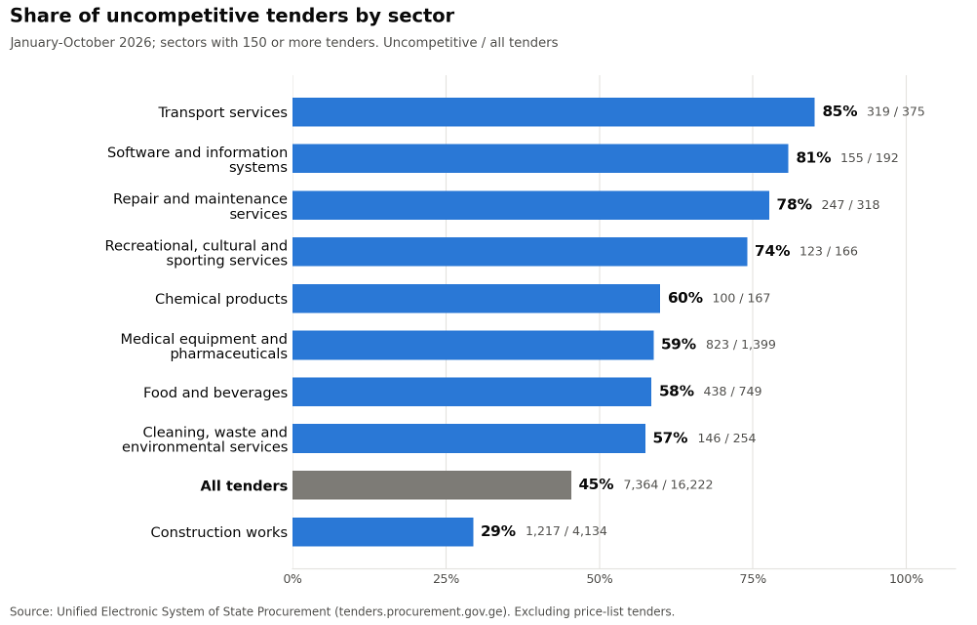
The share of uncompetitive tenders is especially high in several sectors:
- Transport services: 85% of tenders
- Software and information systems: 81%
- Repair and maintenance services: 78%
- Medical equipment and pharmaceuticals: 59%
In construction works the share was lower, 29%, but these tenders account for the largest amount: uncompetitive construction contracts are worth GEL 517.9 million.
In some municipalities uncompetitive tenders exceed 50%
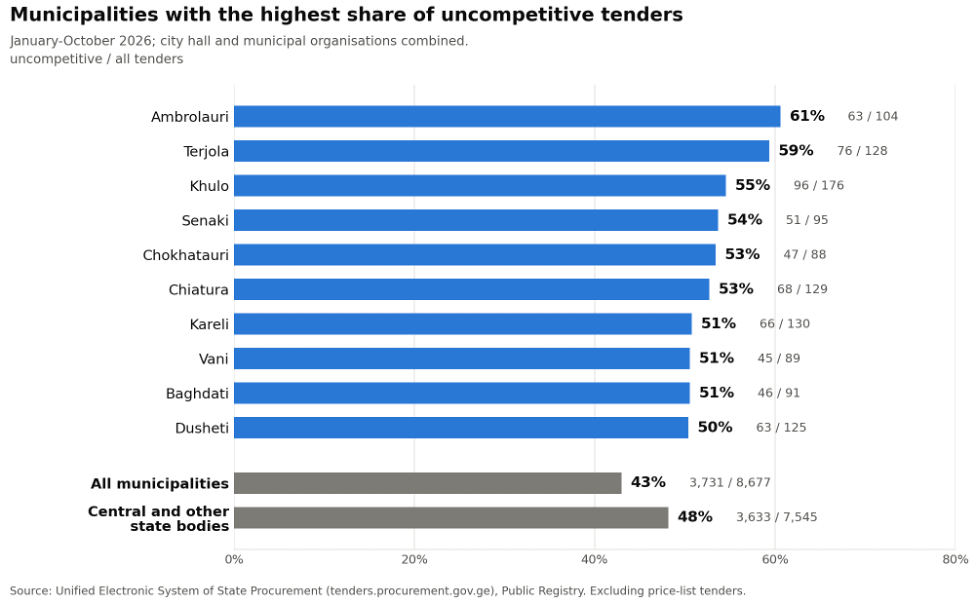
In municipalities, including city halls and the organizations they have founded (legal entities of public law, non-profit legal entities, LLCs), 43% of tenders were uncompetitive, compared with 48% in central and other state bodies. In some municipalities, however, the share of uncompetitive tenders exceeds 50%: the highest shares are in Ambrolauri (61%), Terjola (59%) and Khulo (55%). By value the difference is smaller: uncompetitive tenders account for 32% of the value of municipal procurement (GEL 625 million of GEL 1.97 billion), and for 33% in central and other state bodies. The largest amounts come from Tbilisi and Batumi: Tbilisi signed GEL 277 million in contracts without competition, 38% of its procurement, and Batumi GEL 63 million (30%).
By share of value, the highest figures are in Khashuri (GEL 18.0 million of GEL 33.4 million, 54%), Kareli (GEL 9.1 million of GEL 19.5 million, 47%) and Terjola (GEL 6.0 million of GEL 13.3 million, 45%).
The problem is not new
In September 2024, Transparency International Georgia wrote that half of the large tenders (above GEL 5 million) announced in January-July 2024 and contracted by 23 August were uncompetitive: 38 of 76. The 2026 data show that the problem is not limited to large tenders: half of the tenders worth up to GEL 100,000 had only one bidder.
Among other reasons, the high share of uncompetitive tenders may be explained by procurement terms being tailored to particular suppliers. Some examples:
- In June 2026, Transparency International Georgia described a case in which Batumi's Urban Infrastructure and Amenities Division required bidders in five road rehabilitation tenders to own, or have a contract with, an asphalt plant within a 30-kilometre radius of the site. Among them was a tender worth GEL 29.2 million in which Gza LLC was the only bidder.
- In January 2023, the Penitentiary Service signed a contract worth GEL 103.5 million for prisoner meals with Ili Group LLC, the only bidder in the tender. The heads of several companies told Radio Liberty that the prison catering tender was tailored to Ili Group and there was no point in taking part.
- In April 2023, JSC Georgian Railway required at least 20 years of continuous experience from bidders in a tender for security services worth GEL 7.8 million. Only two companies in the country met this condition. The only bidder was Intersecurity-Georgia LLC, owned by Ioseb Alavidze, a former head of the Tbilisi police. The company's bid was equal to the estimated value.
- In January 2022, Rustavi City Hall disqualified the lowest bidder from a tender for social canteens because the amounts in its revised price table were given to four decimal places instead of two. As a result, the contract was signed with a company whose bid was GEL 155,000 higher.
- In 2020, Transparency International Georgia wrote that the technical specifications of the New Year lighting and Christmas tree tenders (about GEL 3.3 million) of Tbilservice Group LLC, owned by Tbilisi Municipality, used photos of products of the Italian company IDO SRL. IDO SRL was the winner and the only bidder in all four tenders.
The State Procurement Agency, meanwhile, measures competition by the average number of bidders per tender. According to its 2025 annual report, this average rose from 2.02 to 2.22 in one year, which the Agency calls “a direct indicator of growing competition”. However, according to the Agency's earlier reports, the figure was 2.27 in 2020, so the 2025 figure is lower than five years earlier. This year the figure is 2.21. Most importantly, none of the Agency's annual reports for 2019-2025 says how many tenders had only one bidder. An average of more than two bidders does not show that almost half of the tenders had no competition.