The Persecution of Georgian Fighters: A Joint Operation by Ivanishvili’s Government and the Kremlin?
Introduction
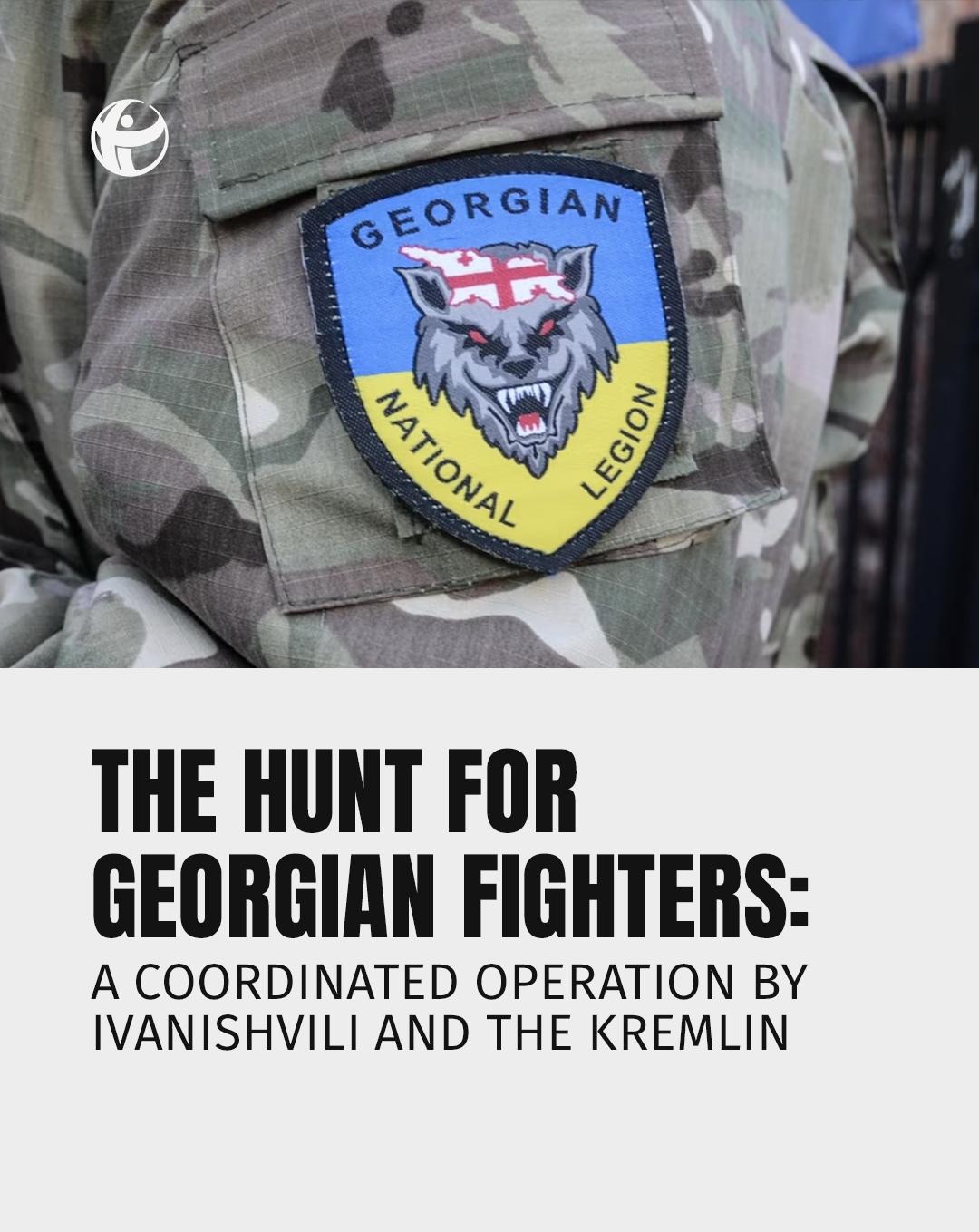
Following Russia’s full-scale invasion of Ukraine in 2022, hundreds of Georgian citizens decided to volunteer to fight against the Russian occupying forces in Ukraine. For them, defending Ukraine’s freedom is closely linked to defending the freedom of their own homeland, Georgia, since large parts of the territories of both countries are occupied by the same aggressor state.
The participation of Georgian volunteers in the fighting against the Russian occupying forces provoked a particularly strong reaction from the Russian authorities. The Russian Prosecutor’s Office initiated criminal proceedings against several individuals. Subsequently, some of these Georgian citizens were also subjected to criminal or administrative proceedings in Georgia, suspiciously coinciding with the actions taken by the Russian authorities.
In addition, it is noteworthy that the United Kingdom imposed sanctions on four Georgian nationals who support Kremlin policies: Mamuka Phipia, Giorgi Iremadze, Nikoloz Mzhavanadze, and Paata Abuladze. The stated grounds for the sanctions were the dissemination of Russian disinformation and actions aimed at destabilising Ukraine or threatening its territorial integrity, sovereignty, or independence. In 2025, these individuals met with the so-called head of Donetsk, a territory occupied by Russia.
Among other matters, the meeting reportedly addressed the issue of handing over to the Georgian side a list of Georgian fighters. The so-called head of Donetsk told the Georgian side that he would provide a list of Georgian fighters in Ukraine and asked that they be punished by the Georgian authorities. The so-called Donetsk leader stated that Abuladze had been holding meetings with them on behalf of the Georgian Dream party, although Abuladze himself denies this.
Our study focuses on Georgians who were prosecuted by the Russian authorities and who, following the initiation of proceedings against them in Russia, also became targets of prosecution in Georgia. Examples include the cases of Gia Baramidze, Aleko Elisashvili, Irakli Okruashvili and Davit Katsarava, as well as actions taken against Mamuka Mamulashvili and other Georgian volunteers fighting in Ukraine.
Such coincidence does not, in itself, establish coordination or concerted action between Georgian and Russian authorities. However, when public discrediting is followed by criminal prosecution, imprisonment, or other severe measures, there are reasonable grounds to suspect that Ivanishvili’s government is taking such actions in an attempt to curry favour with the Russian authorities.
1. Propaganda and Public Discreditation Campaign
The Russian authorities’ negative rhetoric, threats and hostility towards representatives of Georgia’s previous government have been known to the public for many years. Ivanishvili’s government has been no less active in this regard. Particularly striking is the campaign of discreditation directed against Georgia’s third president, Mikheil Saakashvili, which has been ongoing for almost 15 years and has, on numerous occasions, been linked to the wishes of the Russian president.
Following Russia’s full-scale invasion of Ukraine, Georgian volunteers fighting in Ukraine also became targets of a similar negative communications campaign. As early as 2022, immediately after Russia launched its aggression, then-Prime Minister Irakli Garibashvili publicly referred to Georgian volunteers travelling to Ukraine on a charter flight as “mercenaries.”
The discreditation campaign was subsequently accompanied by statements warning of the potential loss of Georgian citizenship. On 7 December 2022, Mamuka Mdinaradze stated that enlistment in the armed forces of another country would automatically result in the loss of Georgian citizenship. The following day, a similar statement was made by Rati Ionatamishvili. Around the same time, Irakli Kobakhidze, then chairman of Georgian Dream, claimed that enlistment in the defence forces of another country amounted to acquiring that country’s citizenship. These statements constituted a message threatening Georgian volunteers fighting in Ukraine with the loss of their citizenship.
These statements were made against the backdrop of a negative campaign directed against Ukraine, its political leadership, and President Volodymyr Zelenskyy personally. Government representatives promoted a narrative that Ukraine allegedly wanted to drag Georgia into the war.
2. The Arrest and Prosecution of Giorgi Baramidze
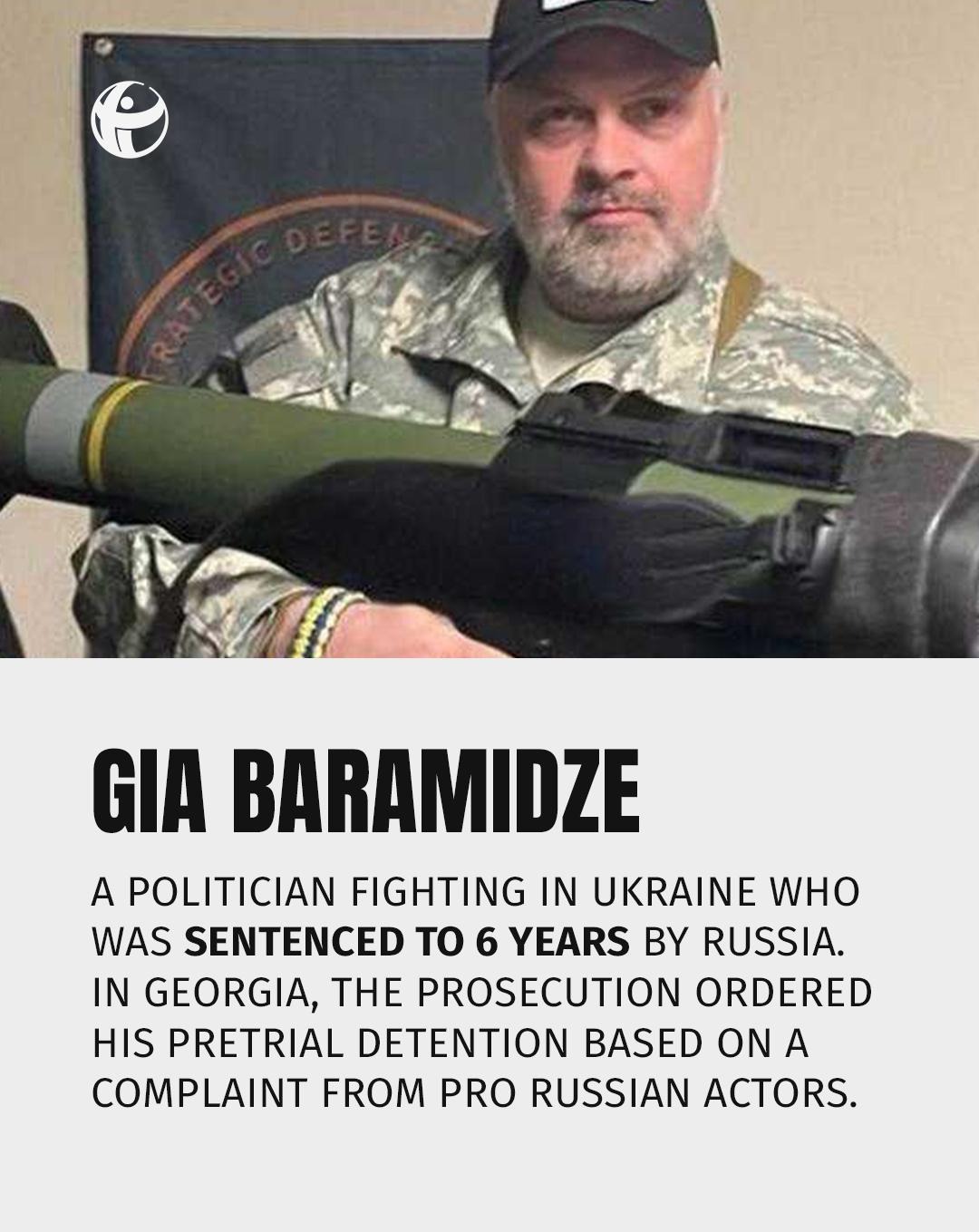
When he fought in Ukraine: Gia Baramidze, a current opposition politician and former Defence Minister of Georgia, fought against Russia in the Russia-Ukraine war in 2022.
What he was convicted of in Russian-occupied Donbas: On 3 February 2026, a court in Donetsk, a Ukrainian region occupied by Russia, found Giorgi Baramidze guilty of being a “mercenary” fighting for Ukraine and, in absentia, sentenced him to six and a half years’ imprisonment.
What he is charged with in Georgia: On 11 September 2026, Georgian law-enforcement authorities arrested him at his home in Tbilisi. The Prosecutor’s Office has charged him under Article 318 of the Criminal Code with sabotage and under Article 307¹ with the offence of “treason against the homeland.” The case concerns controversial remarks made by Giorgi Baramidze during an online programme devoted to a review of Georgia’s recent history, in which he addressed the issue of prisoner exchanges. His views provoked understandable indignation in various circles, including among veterans. He subsequently apologised for his statement, saying that he had been misunderstood and that he should have chosen his words more carefully.
Lack of a legal basis for the charges: The offence with which the Prosecutor’s Office has charged Giorgi Baramidze consists of “interfering with the normal functioning of a state or other enterprise, institution, organisation or service with the aim of weakening Georgia.”
Thus, for the elements of the offence to be established, the following must exist:
- an intention to weaken Georgia;
- an act of interfering with the normal functioning of a state or other enterprise, institution, organisation or service;
- a causal link between the interference and the conduct of the individual concerned.
As follows from the Prosecutor’s Office’s statement, Giorgi Baramidze is being prosecuted solely in connection with a statement he made publicly. Such a statement cannot constitute sufficient and relevant grounds for a conviction beyond reasonable doubt. The statement itself does not demonstrate what constituted an intention to weaken Georgia; which enterprise, institution, organisation or service was prevented from functioning normally; or, assuming that such interference occurred, what causal link existed between Giorgi Baramidze’s statement and the alleged result.
Moreover, from a purely legal perspective, applying Articles 318 (sabotage) and 307¹ to a public statement made during an online programme is directly contrary to the standards protecting freedom of expression under Article 10 of the European Convention on Human Rights (ECHR). A public statement, even if extremely harsh or factually inaccurate, does not satisfy the objective element of a criminal offence (actus reus) in the absence of an immediate and real danger.
Given that the case concerns an especially sensitive context that is historically painful for the country, and that the charges have been brought against a former Defence Minister and a sitting opposition politician, the Prosecutor’s Office is under an even greater obligation to conduct the prosecution with a high degree of precision and on the basis of compelling evidence. At this stage, the Prosecutor’s Office’s public statement creates the impression of politically motivated prosecution.
It is also noteworthy that the investigation was initiated on the basis of a statement by the Legal Entity of Public Law “State Service for Veterans Affairs.” According to members of the United National Movement, the statement was signed by Koba Liklikadze, Malkhaz Topuria and Koba Kobaladze. It should be noted that one of these individuals, Malkhaz Topuria, is a signatory of a letter addressed to Vladimir Putin calling for Georgia’s military neutrality and the restoration of relations with Russia.
The letter begins as follows: “Your Excellency, Mr President!” [referring to Vladimir Putin] “We regret to inform you that Georgia is not a free country, as evidenced by statements by high-ranking officials that the United States of America interferes in Georgia’s internal affairs. Contrary to the interests of the country, the Georgian government is providing territory for NATO military exercises, which is nothing other than a provocation of Russia.”
A similar pro-Russian statement, also signed by Malkhaz Topuria, was published on 2 August 2021.
Illegality of pre-trial detention: Even if the commission of a crime had been established in the present case to the standard of reasonable suspicion—which it has not been—this would still not automatically justify the imposition of pre-trial detention, since detention requires a separate and specific justification. In particular, detention may be imposed as a preventive measure only where there is a risk that the accused will abscond, continue criminal activity, exert pressure on witnesses, destroy evidence, or prevent the enforcement of a judgment.
In the present case, given that the Prosecutor’s Office is accusing Gia Baramidze of making a public statement, it is difficult to see how the accused could have destroyed any evidence or exerted pressure on any witness. Since the statement was made publicly through the media, there is no realistic possibility of secretly destroying evidence. Furthermore, under the case-law of the European Court of Human Rights, detention is an exceptional measure and may not be used in advance as a form of punishment.
As regards the risk of absconding, although the investigation was opened on 7 August 2026, Baramidze was arrested at his home on 11 September 2026, and the Prosecutor’s Office has not publicly presented a single piece of evidence suggesting that Baramidze posed a risk of absconding. It is therefore pertinent to ask what evidence led the court to conclude that the accused’s conduct or circumstances created such a risk that the most severe form of preventive measure was necessary to prevent it, and that this objective could not have been achieved through a less restrictive measure.
3. The Arrest and Conviction of Aleko Elisashvili
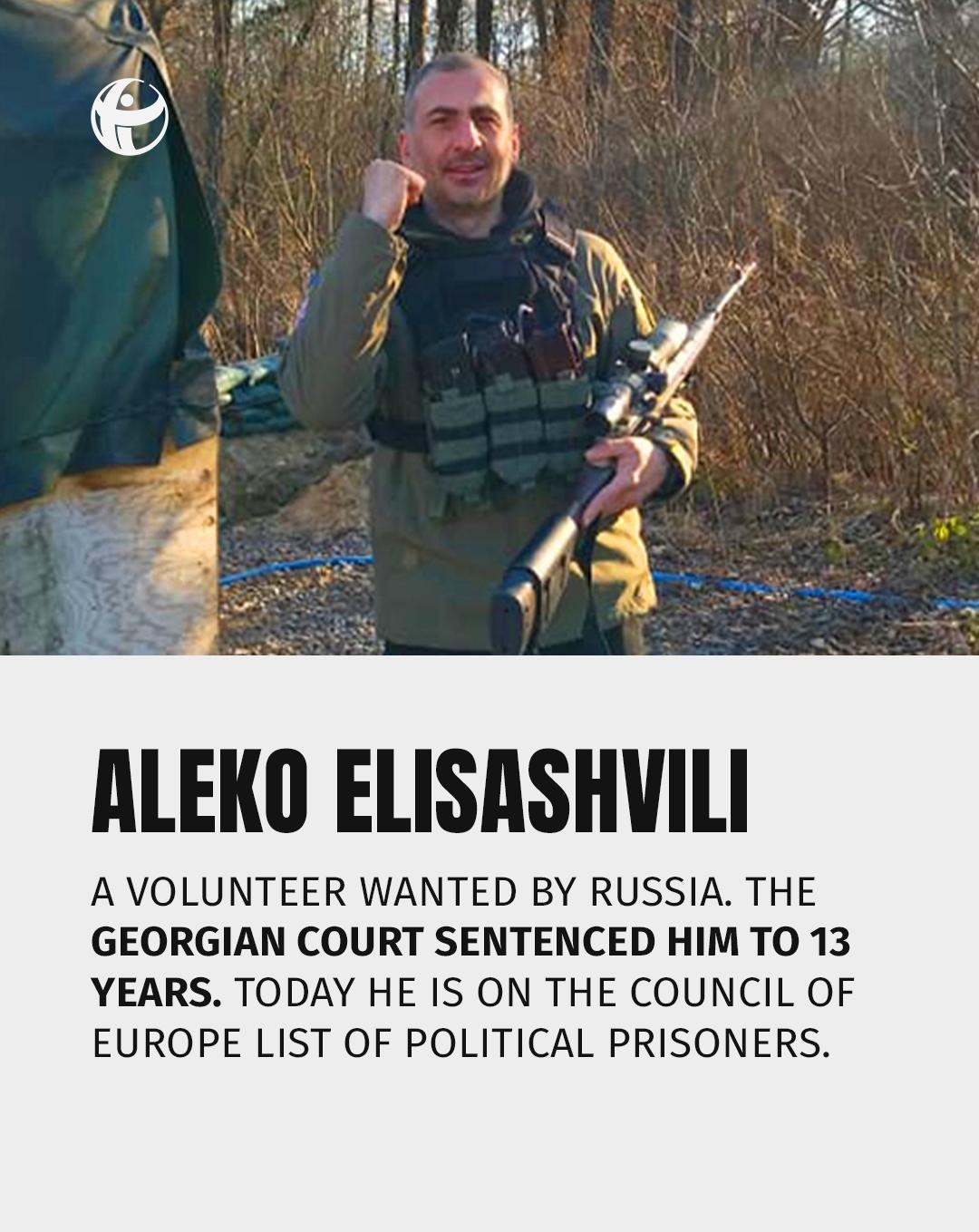
When he fought in Ukraine: Like Gia Baramidze, Aleko Elisashvili fought against Russia in the Russia-Ukraine war in 2022.
What he is charged with in Russia: On 5 August 2025, the Russian Prosecutor General’s Office placed him on an international wanted list. He was charged in absentia under Article 359(3) of the Criminal Code of the Russian Federation (participation as a mercenary in an armed conflict).
What he was convicted of in Georgia: Aleksandre (Aleko) Elisashvili was arrested by Georgian law-enforcement authorities on 29 November 2025 while allegedly attempting to set fire to the reception area of the courthouse building. The Tbilisi City Court found Elisashvili guilty under Article 323 of the Criminal Code (act of terrorism) and sentenced him to 13 years’ imprisonment.
Political nature of the conviction and disproportionality of the sentence: It is important to note that Aleko Elisashvili’s conviction was politically motivated, as an analysis of his case found no indication of the elements of an act of terrorism in his conduct. Although his conduct did contain elements of a criminal offence, the court should have convicted him under Article 187(a) of the Criminal Code, which concerns damaging another person’s property by arson, explosion or another generally dangerous means and carries a maximum sentence of six years’ imprisonment. Moreover, the court should have taken into account that the offence was merely attempted and had not been completed, which should have resulted in the imposition of a less severe sentence.
The artificial escalation of the legal classification of the conduct and the application of a terrorism provision point to a classic instrument of politically motivated justice. For this reason, following an analysis of the case materials, Transparency International Georgia concluded that Aleko Elisashvili meets the criteria established by Parliamentary Assembly of the Council of Europe (PACE) Resolution No. 1900 and, on that basis, included him on the organisation’s list of “political prisoners.”
4. The Arrest and Conviction of Irakli Okruashvili
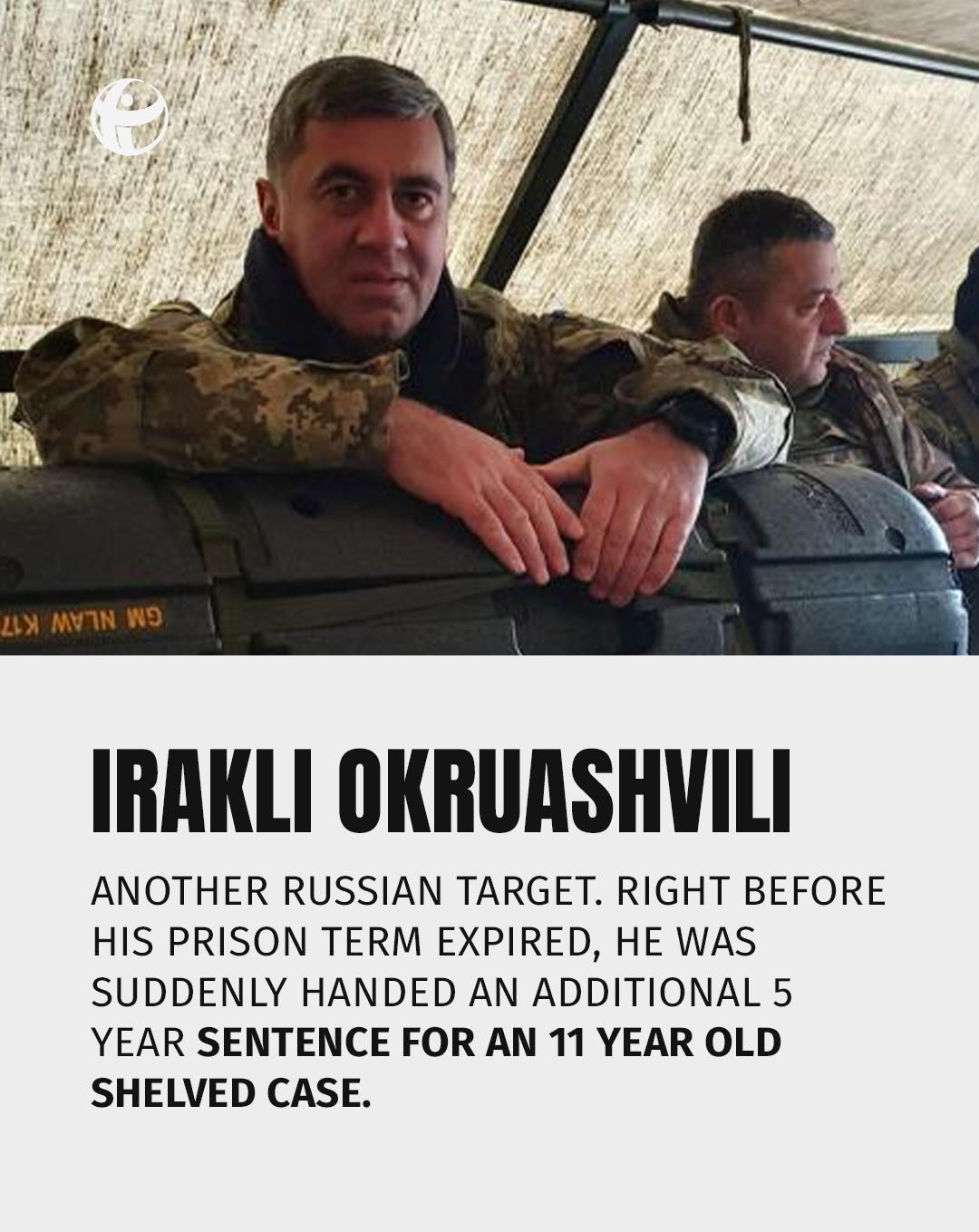
When he fought in Ukraine: Like Aleko Elisashvili and Gia Baramidze, Irakli Okruashvili fought against Russia in the Russia-Ukraine war in 2022.
What he is charged with in Russia: Criminal proceedings have been instituted against him in Russia, and he has been placed on a wanted list on the same grounds—participation as a mercenary in an armed conflict.
What he has been convicted of in Georgia: Irakli Okruashvili has been prosecuted twice by the Georgian justice system.
He was first arrested by Georgian law-enforcement authorities in 2025. He was accused of failing to appear before a parliamentary commission established by Georgian Dream.
According to Transparency International Georgia, the temporary parliamentary investigative commission established in February 2025 was an unlawful mechanism created by Georgian Dream to destroy opposition political parties and eliminate pluralist democracy in the country. Some opposition politicians refused to participate in the commission. Their reasoning was political: they did not recognise the Georgian Parliament as a legitimate body, which formed the basis for their refusal to appear before the commission.
Georgian Dream transformed this political decision into a criminally punishable act, and the Prosecutor’s Office initiated proceedings against a number of politicians. Equating a political boycott with a criminal offence and imposing imprisonment for such conduct constitutes an extremely repressive and politically motivated legal practice.
The court sentenced Irakli Okruashvili to eight months’ imprisonment. He was due to be released in January 2026. However, as that date approached, in November 2025 the court delivered a judgment in the long-running Buta Robakidze case and sentenced Irakli Okruashvili to five years and three months’ imprisonment.
It is noteworthy that the investigation in that case had been ongoing since 2013 and Okruashvili had been charged since 2019. Nevertheless, the judgment was delivered unexpectedly, precisely when he was already serving a sentence on other grounds and was due to be released shortly. The activation of a case that had been “shelved” for years precisely when the individual’s previous sentence was about to expire is a clear indicator of the use of the justice system as a political instrument.
5. The Case of Mamuka Mamulashvili, Commander of the Georgian National Legion in Ukraine
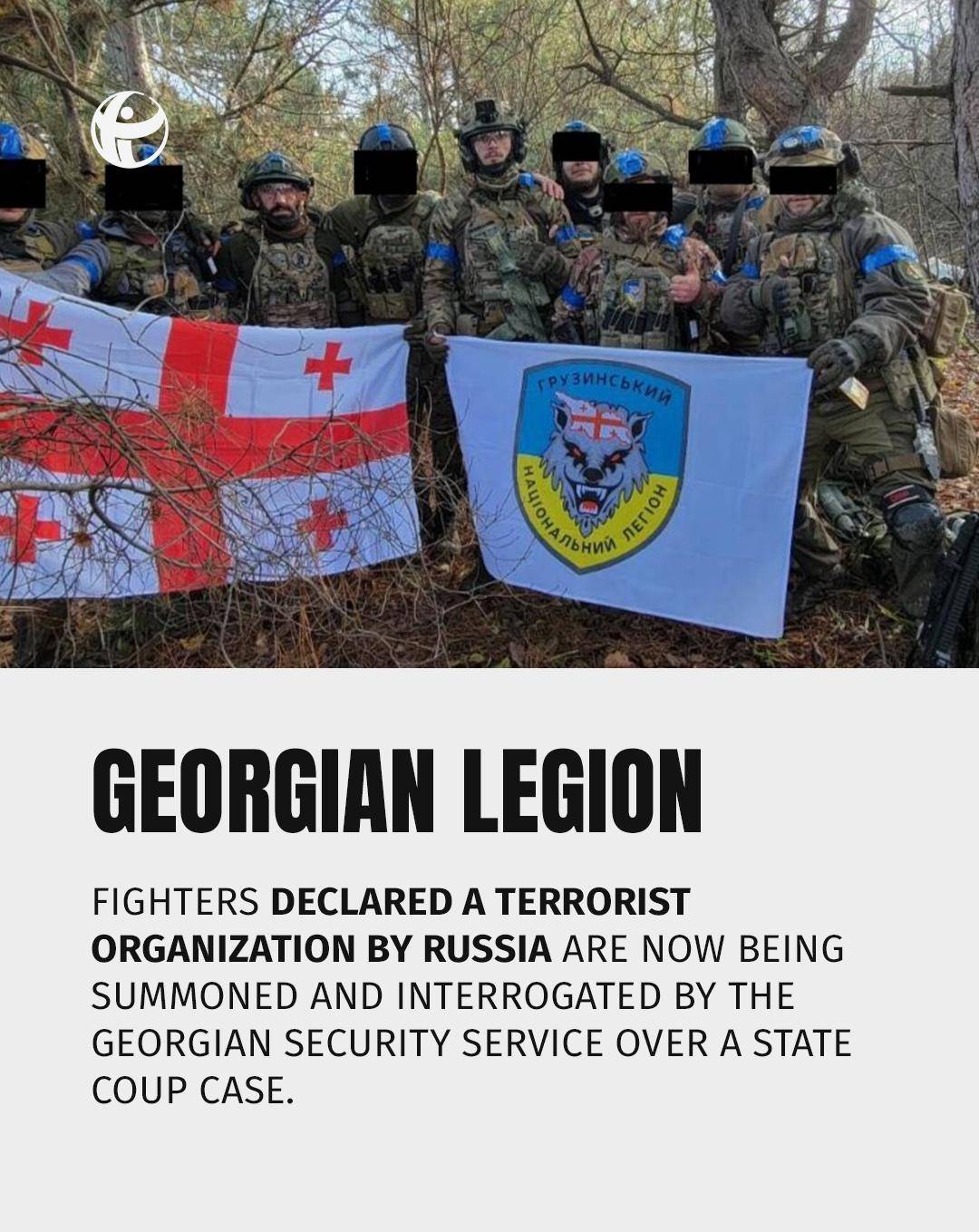
Criminal prosecution and conviction in Russia: Mamuka Mamulashvili, commander of the “Georgian National Legion,” which fights in Ukraine, is one of Russia’s principal targets. Russia has designated the “Georgian Legion” as a terrorist organisation and has placed Mamulashvili himself on its wanted list.
In 2023, more than 70 members of the Legion were prosecuted along with Mamulashvili. According to Mamulashvili, Russia identified these fighters through cooperation with Georgia. Russia accused them of “violating the laws and customs of war against servicemen of the Russian Armed Forces and members of the National Guard.”
In 2024, the Russian Federation brought another charge against Mamulashvili, allegedly concerning mercenary activity and incitement of hatred through the media. As a result, he was sentenced in absentia to 23 years’ imprisonment, and he was subsequently placed on federal and international wanted lists.
Persecution by Georgian law-enforcement authorities: It is noteworthy that, following Russia, Mamuka Mamulashvili also became a target of Georgia’s State Security Service. In 2023, the State Security Service identified him as one of the alleged organisers of a conspiracy aimed at “organising civil unrest and destabilisation and changing the government” in Georgia between October and December. The Security Service claimed that Mamulashvili was training groups in the use of weapons near the Polish-Ukrainian border.
Thus, the allegations made by the Georgian State Security Service and the Russian special services became substantively aligned. Both authorities accuse the Georgian commander of seeking to “organise destabilisation” and of using terrorist methods.
6. Other Forms of Repression: The Torture and Administrative Sanctioning of Davit Katsarava
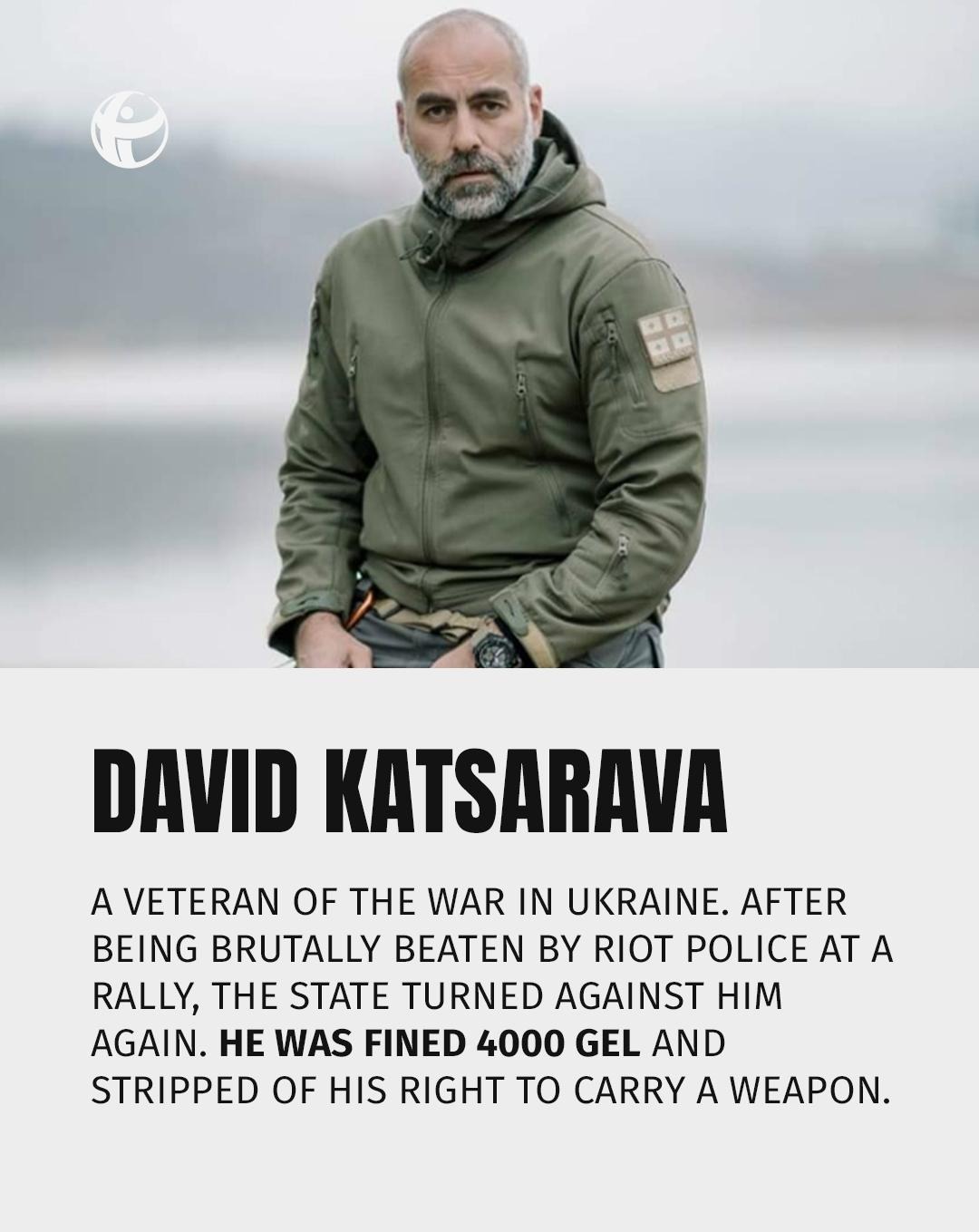
When he fought in Ukraine: Since 2006, Davit Katsarava has headed the anti-occupation movement “Strength in Unity,” which for years has monitored villages along the administrative boundary line of the Tskhinvali region and documented instances of Russia’s “creeping occupation” along the dividing line.
In 2022, immediately following the beginning of Russia’s full-scale invasion of Ukraine, Davit Katsarava himself travelled to Ukraine to fight against Russia.
Torture: On 14 May 2024, during the dispersal of a protest against the Law on Transparency of Foreign Influence, Davit Katsarava was arrested and brutally beaten by riot police, as a result of which he required hospitalisation and surgery.
Imposition of an administrative sanction: Shortly after his arrest, proceedings were initiated not against the law-enforcement officers who had assaulted him, but against Davit Katsarava himself. The Ministry of Internal Affairs accused him of disobeying the police and committing petty hooliganism. In July 2024, the court found Davit Katsarava liable for an administrative offence, fined him GEL 2,000 and additionally deprived him of the right to carry a firearm for two years.
Imposition of another administrative sanction: Almost a year later, in June 2025, the Ministry of Internal Affairs once again initiated administrative proceedings against Davit Katsarava. This time, the court imposed a GEL 4,000 fine and an additional three-year ban on carrying firearms. The Ministry of Internal Affairs accused Katsarava of insulting a public official in a social-media post describing his personal experience of being beaten in May 2024.
7. Summoning Georgian Volunteers Fighting in Ukraine for Questioning
In 2024, Georgia’s State Security Service summoned Georgian citizens who had volunteered to fight in Ukraine for questioning. Nadim Khmaladze, Vazha Tsertsvadze and anti-occupation movement activist Lasha Chighladze reported receiving such summonses. According to reports, the State Security Service accused them of plotting a coup d’état. One of those questioned, Lasha Chighladze, stated that he had been asked questions concerning his participation in the fighting in Ukraine.
The questioning was conducted as part of an investigation initiated under Articles 315 (“conspiracy or rebellion aimed at violently changing Georgia’s constitutional order”) and 323 (“terrorism”) of the Criminal Code. This once again underscores the radical and politically motivated nature of the unlawful campaign pursued by the state against volunteer fighters.
Mamuka Mamulashvili, commander of the “Georgian Legion” fighting in Ukraine, stated that approximately 300 people who fought in Ukraine are wanted in Georgia.
Conclusion
Defending Georgia’s independence, sovereignty and territorial integrity is a matter of common national interest.
The cases discussed in this blog should be assessed within the broader political context shaped in recent years by the Georgian authorities’ policy of distancing the country from the West and moving closer to Russia.
Against this background, a noteworthy sequence of events emerges: criminal proceedings initiated by the Russian authorities against particular individuals are followed by prosecution of the same individuals in Georgia, accompanied by public campaigns of discreditation. The cases examined reveal concerns regarding the correctness of the legal classification of the conduct, the substantiation of the charges, and the proportionality of the measures applied.
Considered individually, the cases discussed in this blog might give the impression of isolated coincidences. Taken together, however, they point to a consistent policy pursued by the Georgian authorities targeting Georgian citizens who, following Russia’s invasion of Ukraine in 2022, fought on Ukraine’s side against Russia. What these individuals have in common, therefore, is that they have been subjected to parallel prosecution and conviction in the Russian Federation and in Georgia.
When the law-enforcement and justice systems of both Russia and Georgia act in parallel against the same individuals, this naturally raises serious questions as to whether the policy pursued by the Georgian authorities is consistent with the country’s national interests.