
Ivanishvili MPs’ Lawsuit Seeking to Ban Political Parties Contravenes Article 23(3) of the Constitution
Introduction
As is well known, Ivanishvili’s compliant Constitutional Court managed, within an unprecedentedly short period of barely three weeks from the filing of the latest version of the constitutional claim by Ivanishvili’s own MPs, to refer the case to the Court’s Plenum, admit the claim for consideration on the merits, and schedule the hearings on the merits for 21–23 October.
Such speed, considered alongside the current composition of the Constitutional Court and its decisions in recent years, including those concerning the constitutionality of the elections, the so-called “Russian law” and the impeachment of President Salome Zourabichvili, among others, leaves virtually no doubt that the Court will uphold the claim.
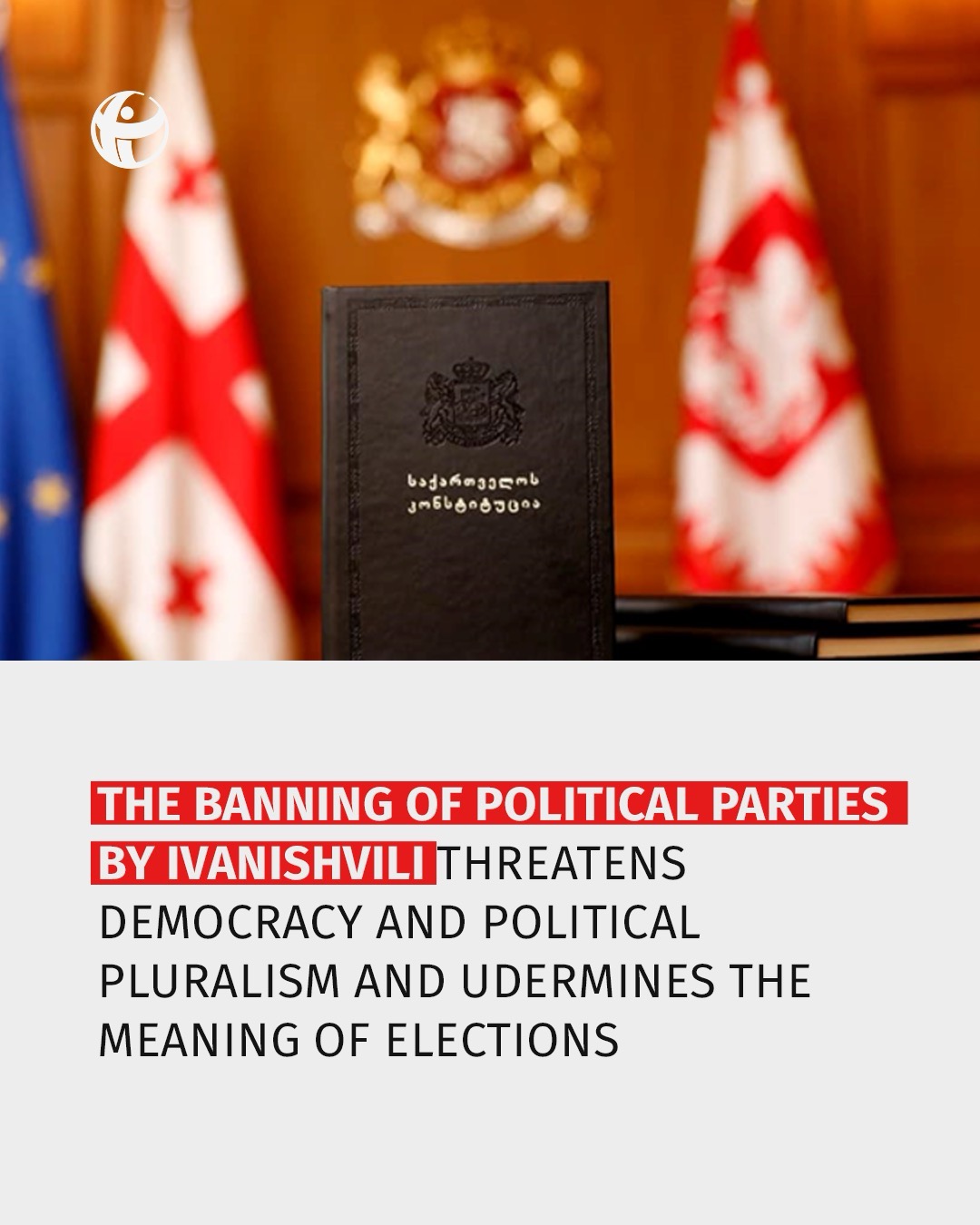
Banning the political parties named in the application would, in effect, amount to banning the entire pro-Western opposition political spectrum. It would mean that the Ivanishvili regime would deprive approximately 40% of the electorate of any meaningful electoral choice. According to the results announced even by the regime-controlled Central Election Commission, this was the proportion of voters who voted for the parties now facing a ban in the 2024 parliamentary elections. Eliminating such a choice would mean the end of political pluralism and, indeed, the end of electoral democracy itself.
Approximately one year ago, Transparency International Georgia published an in-depth analysis of the constitutional claim seeking to ban political parties. This time, we offer a brief assessment of the revised claim, confined strictly to legal analysis and excluding any thorough examination of the potential political, geopolitical or other consequences of the Constitutional Court’s likely decision.
1. Legal Standards for Assessment
Article 23(3) of the Constitution of Georgia permits the prohibition of a political party only on specific, exhaustively enumerated grounds:
- Pursuing the objective of overthrowing or forcibly changing the constitutional order of Georgia, or encroaching upon the country’s independence or violating its territorial integrity;
- Advocating war or violence;
- Inciting national, ethnic, regional, religious or social discord.
A ban on a political party could be constitutionally justified only if the applicants established that the respondent political parties pursued one of the objectives listed above or engaged in one of the activities described therein.
At the outset, it should be noted that the constitutional claim lacks an evidentiary foundation. The sole item of evidence annexed to it is the conclusion of the so-called parliamentary temporary investigative commission (the “Tsulukiani Commission”). That commission was established in violation of the Constitution and the Rules of Procedure of Parliament, operated under a mandate extending well beyond the limits prescribed by those Rules, and produced a report consisting largely of speculation and conjecture based on the testimony of questionable witnesses.
2. Assessment of the Specific Factual Allegations in the Claim in Light of Article 23(3) of the Constitution
A. Systematic Human Rights Violations in 2004–2012
The claim associates the period during which the United National Movement was in power with torture and ill-treatment, killings, unlawful surveillance, infringements of property rights, pressure on businesses and restrictions on media freedom. It refers to specific cases, including those of Buta Robakidze, Sandro Girgvliani and Zurab Vazagashvili, as well as judgments of the European Court of Human Rights.
Numerous serious human rights violations did indeed occur while the United National Movement was in power. However, establishing that a party’s representatives violated the law and human rights is not, in itself, sufficient to justify banning that party. The relevant facts must be linked to at least one of the grounds expressly enumerated in the Constitution, and it must be demonstrated that the conduct in question was underpinned by an objective attributable to the party or gave rise to the relevant constitutional threat. The feeble attempt by Ivanishvili’s MPs to argue that “systematic and repeated violations of human rights” may themselves constitute the overthrow or forcible alteration of the constitutional order is wholly unconvincing to any objective observer.
Even putting that aside, it is unclear how unlawful acts committed by public officials under the government in power between 2004 and 2012 could be attributed to the other respondent political parties, whose representatives either had no connection whatsoever with the government of that period or, where such connections existed, played no role in the alleged crimes.
B. Rejection of Election Results, Boycotts and Opposition Cooperation
The claim describes in detail how, following the elections of 2016, 2018, 2020, 2021 and 2024, individual parties rejected the legitimacy of the election results, boycotted Parliament or other elected bodies, declined to take up their mandates and demanded early elections. In the same context, the claim examines the establishment of the “Opposition Alliance” on 2 March 2026 and its declared political principles.
These circumstances do not constitute grounds for banning a political party. Article 23(3) of the Constitution does not list the rejection of the “legitimacy” of the authorities or of election results as a ground for prohibition. Nor can such rejection logically be linked to any of the prohibited objectives or activities enumerated in that provision.
Criticising election results, boycotting elected bodies, declining to exercise parliamentary mandates and calling for a change of government are common forms of political expression and opposition activity. They are entirely consistent with the constitutional principles of freedom of expression and freedom of political association. They cannot be equated with an unconstitutional objective, namely, “overthrowing or forcibly changing the constitutional order”.
C. Alleged Attempts to Overthrow the Government and Acts of Violence in 2019–2025
A substantial part of the claim concerns the events of 20–21 June 2019, the events outside the Central Election Commission building on 8 November 2020, and those outside the Presidential Palace on 4 October 2025. The claim links these events to statements made by opposition parties and their organisation of and support for protests, interpreting this conduct as attempts to storm the Parliament building and the Presidential Palace by force and as incitement to violence against law enforcement officers.
First, political support for a protest, or criminal acts allegedly committed by individual participants, does not automatically mean that the party concerned endorsed or condoned violence, much less that it pursued the objective of overthrowing the government by violent means, assuming such an objective existed at all.
Second, although hundreds of participants in protests held in 2024–2025 have been convicted of offences including organising or participating in group actions, seizing or blocking strategic or facilities of particular importance, sabotage, and calling for the forcible alteration of the constitutional order or the overthrow of state authority, in most cases following gross violations of the fundamental principles of a fair trial, not a single participant has been convicted of conspiracy or insurrection aimed at forcibly changing the constitutional order of Georgia. Yet it is precisely the latter offence, rather than any of the other offences listed above, that could potentially be relevant to the constitutional objective of overthrowing or forcibly changing the constitutional order.
In other words, the opposition parties are accused of organising a crime that, even according to the assessment of today’s biased law enforcement and judicial systems, has never been committed by anyone.
D. The Conduct of Aleksandre Elisashvili
The claim places special emphasis on an incident in which Aleksandre Elisashvili allegedly set fire to a court building and a separate alleged attempt to do so, as well as on the reaction of representatives of the Strong Georgia party to these events. A criminal offence allegedly committed by one party representative—where both its legal classification in one instance and whether it was committed at all in the other are subject to serious doubt—cannot, of course, suffice to justify banning the party. Nor can the party’s defence of that individual or criticism of his criminal prosecution. Such a ban would require proof of the party’s relevant objective, involvement or support for violence, none of which is evidenced by the material annexed to the claim.
E. Foreign Policy, the August 2008 War and Territorial Integrity
The claim also refers to statements made by opposition parties concerning Abkhazia and Russia, the process of integration into the European Union, calls for international sanctions, and communications with foreign partners.
First and foremost, criticism of the government’s foreign policy, appeals to international organisations or calls for sanctions cannot be regarded as an encroachment upon the country’s independence or a violation of its territorial integrity.
Furthermore, such conduct cannot be linked to any of the relevant grounds for prohibition under Article 23(3) of the Constitution unless a specific connection is established between that conduct and an encroachment upon the country’s independence, a violation of its territorial integrity or another expressly enumerated prohibited objective. No such evidence exists.
The applicants’ position concerning the August 2008 war rests on the assertion that, between 2004 and 2008, the United National Movement government “systematically engaged in war rhetoric, displayed militaristic ambitions and pursued confrontational actions and measures aimed at escalating the conflict”, thereby, in the applicants’ assessment, leading the country into the August 2008 war. The applicants contend that the government of the time created the conditions for Russian occupying forces to invade Georgia, and that the war significantly undermined the prospects of restoring Georgia’s territorial integrity by peaceful means while consolidating Russia’s position with respect to the occupied territories. To substantiate these arguments, the applicants once again rely on the findings of the temporary parliamentary investigative commission.
The fundamental weakness of this position is the complete absence of proof of a causal link. Even if there were some factual basis for accusing the Georgian government of the time of contributing to the escalation of the conflict, that accusation alone would not establish that the government’s policies caused the war or that its political responsibility could be equated with Russia’s military aggression. Russia’s aggression against Ukraine, its war of conquest against that country, which has now continued for more than four and a half years, and its aggressive rhetoric towards anyone who expresses any sympathy for Ukraine, let alone provides it with assistance, demonstrate that Russia does not need any “provocation” to attack a neighbouring country.
It is therefore essential to distinguish between, on the one hand, the assessment and criticism of political decisions and possible policy errors and, on the other, conduct that may be aimed at encroaching upon Georgia’s independence or territorial integrity. The claim not only fails to distinguish between these two categories but treats them as equivalent.
The applicants also classify as conduct undermining the prospects of restoring Georgia’s territorial integrity by peaceful means what they describe as a decision by Giorgi Gakharia, chairman of the political party For Georgia, to establish a checkpoint near the village of Chorchana in 2019, which allegedly had serious consequences for Georgia’s territorial integrity.
Leaving aside the superficiality of this assessment, if Gakharia’s conduct were criminally reprehensible—which it is not—then, applying the very same logic underpinning the entire claim, that conduct, if attributable to any political party at all, should be attributed to Georgian Dream. At the time of the alleged “offence”, Giorgi Gakharia was Minister of Internal Affairs in the Georgian Dream government and became Prime Minister shortly thereafter.
3. Conclusion
In conclusion, the constitutional claim, if upheld, would bring political pluralism and electoral democracy in Georgia to an end. Yet it fails to satisfy any of the conditions prescribed by Article 23(3) of the Constitution of Georgia for banning a political party and does not meet the evidentiary standard required to justify such a ban.
The claim contains no specific, credible and sufficient evidence capable of constitutionally justifying the extreme measure of prohibiting political parties.
The events described in the claim, which are themselves presented through a one-sided and subjective interpretation, would not, even if accepted as true, establish that the respondent political parties pursue any objective expressly prohibited by the Constitution or engage in any of the activities prohibited therein.
The applicants have failed to establish either that the conduct of individual persons can be attributed to the political parties concerned or that the requisite link exists between such conduct and the constitutional grounds for prohibition.